Voxel-Based Detection Benchmark
This page validates whether MRSIPrep's pipeline — across four
registration configurations (ANTs (R+SyN), ANTs (R+Aff), FSL
FLIRT-only, FSL FLIRT+FNIRT — see the note on ANTs transform stages
below) — can recover a known, deliberately-injected metabolic
abnormality via a standard voxel-based-analysis (VBA) group comparison
(randomise -T, FSL's TFCE-corrected permutation test).
A note on the ANTs transform stages, since the two ANTs
configurations compared here are not simply "with SyN" vs. "rigid+affine,
without SyN": mrsiprep's default ANTs transform codes are
ants-mrsi-to-t1-transform=sr (Rigid + SyN — no separate Affine stage)
for MRSI→T1w, and ants-t1-to-mni-transform=s (Rigid + Affine + SyN)
for T1w→MNI. ANTs (R+SyN) is this default, full pipeline. ANTs
(R+Aff) drops only the deformable SyN warp from each stage while keeping
everything else identical — which means, precisely, Rigid-only
MRSI→T1w composed with Rigid+Affine T1w→MNI, not "rigid+affine" at
both stages. antsRegistration always writes each stage's linear
transform to its own independent .mat file regardless of whether a
later SyN stage also ran, so this comparison reuses the exact same
already-computed registrations with no recompute — see "Runs compared"
below.
(The Registration Frameworks benchmark separately compares a genuine ANTs Rigid+Affine configuration — a real second registration run with an actual Affine stage at MRSI→T1w, not a reuse of this page's Rigid-only transform. That page's ANTs (Rigid+Affine) and this page's ANTs (R+Aff) are different registration configurations that happen to share a T1w→MNI stage; don't conflate the two.)
Dataset
SynthMRSI-VBA-Project is a synthetic validation dataset: 32 dummy
subjects, each built from a real T1w anatomical (drawn from
BioPsych-Project/Mindfulness-Project/22q11-Project template subjects) and
model-synthesized MRSI metabolite signal. For subjects assigned
group=1 (16 of 32), a deterministic Gaussian-style signal bump is added
to every voxel inside a specific bilateral anatomical region, per
metabolite, before the signal is warped from the template subject's own
T1w-native space into that dummy subject's MRSI-native space and on into
derivatives/mrsi-orig/. group=0 subjects (16 of 32) receive no
injection. This lets randomise's two-sample group contrast
(group1 > group0) be checked against a known, exact ground truth,
independent of registration backend.
This report covers CrPCr (bilateral Precuneus) and GluGln (bilateral Thalamus) only. The other three injected metabolites (NAANAAG, GPCPCh, Ins) showed no detectable signal above chance for any backend at the injected effect size and are out of scope here.
Spike filter interaction
An earlier version of this benchmark showed near-zero detection across
every metabolite and backend. The root cause: MRSIPrep's biharmonic
spike-repair filter (--spikepc, default 99th percentile) was removing
the injected abnormality before it ever reached registration — a
spatially uniform region injection looks exactly like a spike artifact
under a flat per-voxel threshold. This is now fixed with cluster-size-
aware spike filtering: a connected cluster of spike-thresholded voxels
is only median-repaired/biharmonic-inpainted when its size is at or below
--spike-max-cluster-voxels (default: auto-derived from the MRSI
acquisition's native voxel size — 6 voxels at ~5.0mm/3T-like resolution,
9 voxels at ~3.4mm/7T-like resolution). Larger, spatially coherent
clusters — like a genuine focal abnormality — are left unfiltered. The
default cutoffs were derived from the 90th-percentile connected-cluster
size in a real spike-cluster-size survey across 1075 3T metabolite maps
(BioPsych-Project + Mindfulness-Project) and 445 7T metabolite maps
(22q11-Project).
Runs compared
Four registration configurations were run on the same 32 dummy subjects
(one subject excluded for an independently-confirmed bad registration —
see below), at 2mm MNI resolution, then compared with randomise -T
(500 permutations, two-sample unpaired design, contrast group1 > group0) restricted to each metabolite's population quality mask (CRLB
< 20 in ≥70% of subjects). ANTs (R+Aff) reuses the same
MRSI→T1w and T1w→MNI registrations already computed for the full
ANTs (R+SyN) run, with only the deformable SyN warp dropped from the
resampling transform chain at each stage (see the note above on what
that leaves: Rigid-only MRSI→T1w, Rigid+Affine T1w→MNI) — no
registration recompute needed.
Subjects |
31 of 32 (sub-30 excluded: independently confirmed bad registration at both the MRSI→T1w and T1w→MNI stages, unrelated to the spike-filter fix) |
Group sizes |
15 vs. 16 |
Permutations |
500 |
Resolution |
2mm MNI |
Quality mask |
CRLB < 20 in ≥70% of subjects, per metabolite |
Significance threshold |
|
Injection regions
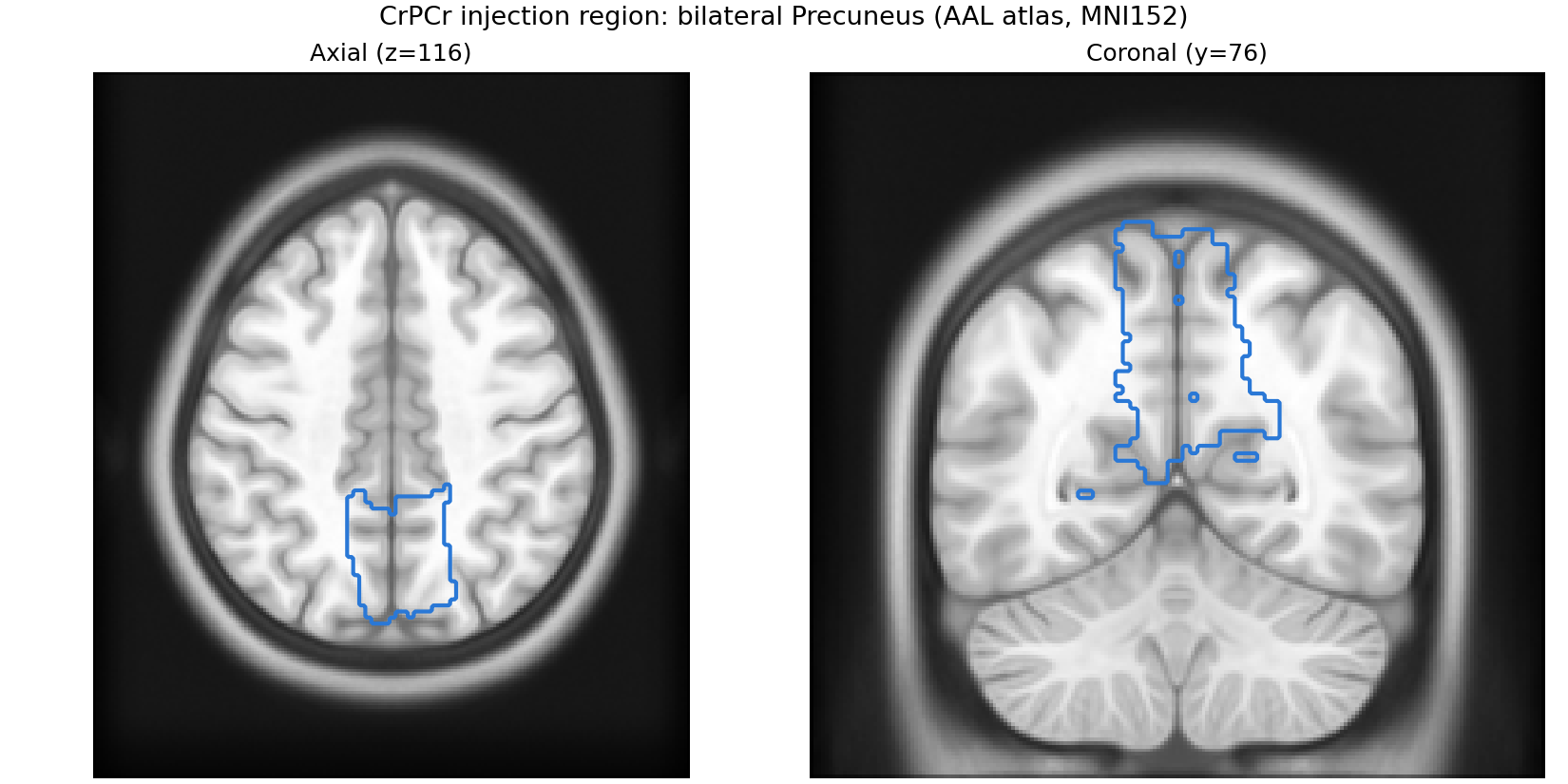
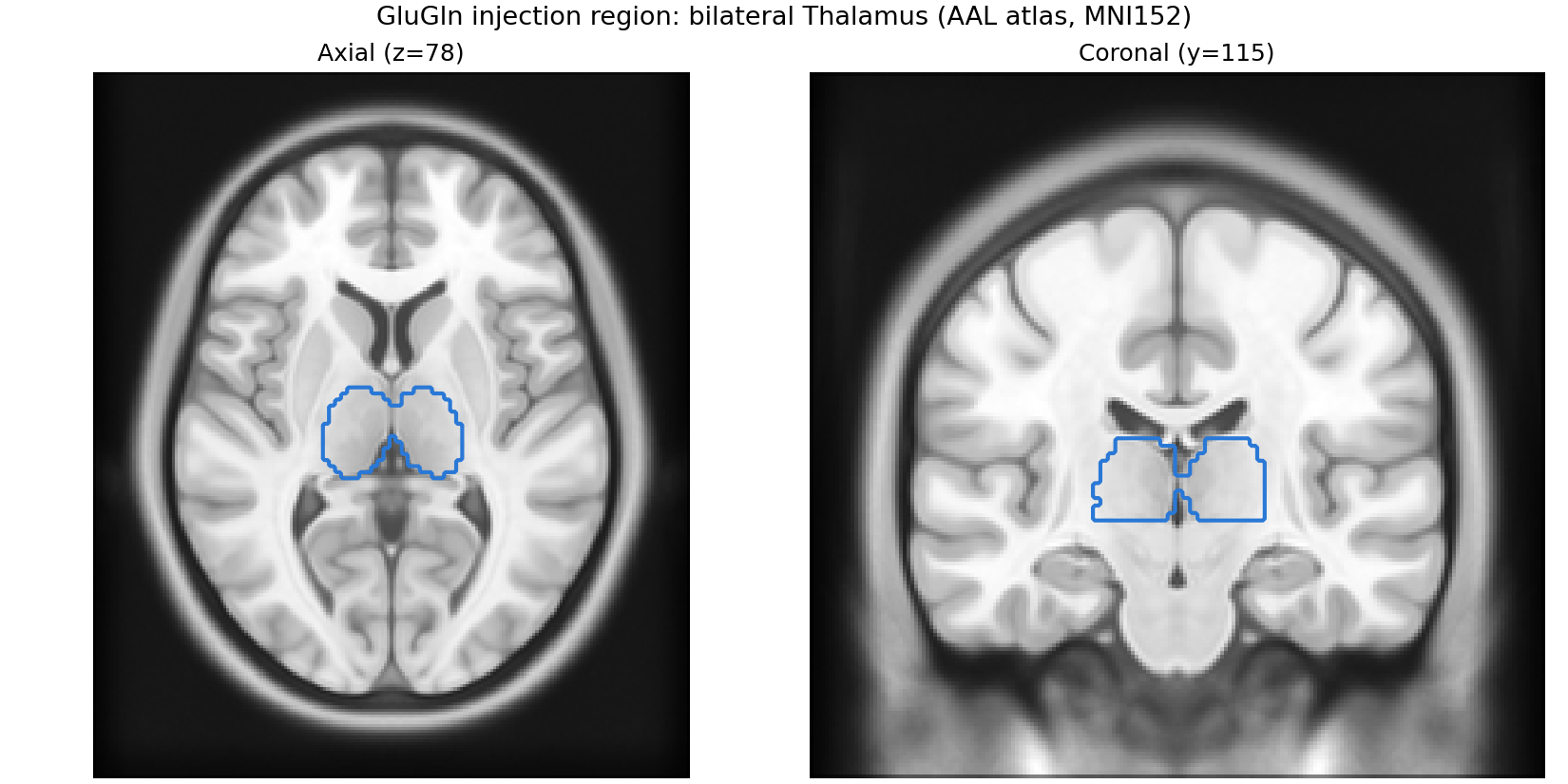
The figures below outline each metabolite's injection region using a
real AAL atlas parcellation image (not the population ground-truth
mask used later in this report) — the same template subject and region
IDs actually used by the injection for one representative dummy subject,
confirmed via derivatives/mrsiprep/synthetic_orig_transform_provenance.tsv:
CrPCr uses AAL region IDs 67/68 (Precuneus L/R), GluGln uses AAL region
IDs 77/78 (Thalamus L/R), from that template subject's own
space-mni_atlas-aal_dseg.nii.gz.
CrPCr — bilateral Precuneus:
GluGln — bilateral Thalamus:
Detection results by backend
For each metabolite, the same axial/coronal slice positions as above show:
Filled (red-yellow): voxels significant at
alpha=0.05from that backend'srandomiseoutput, restricted to the population quality mask.Outline (blue): the population ground-truth injection mask (the per-subject injection masks, averaged across all
group=1subjects and thresholded at >0) — this is the one place in this report the ground-truth mask itself is used, for comparing detected voxels against the known injection footprint.
CrPCr:
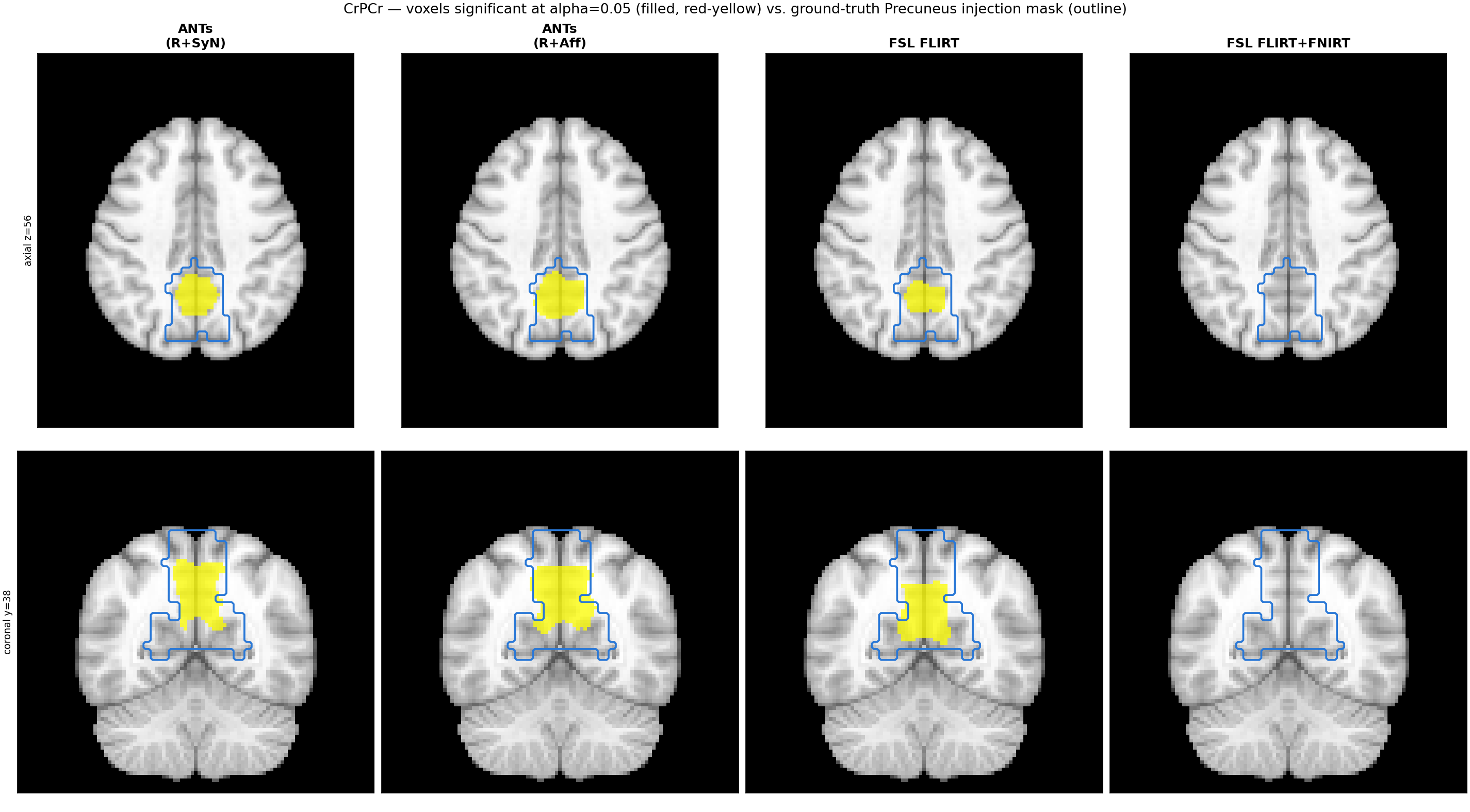
ANTs (both configurations) and FSL FLIRT-only detect a cluster well
inside the true Precuneus region. FSL FLIRT+FNIRT detects no
significant voxels at alpha=0.05 at this slice, consistent with its
near-zero Dice on the GM-precise version of this same comparison below.
GluGln:
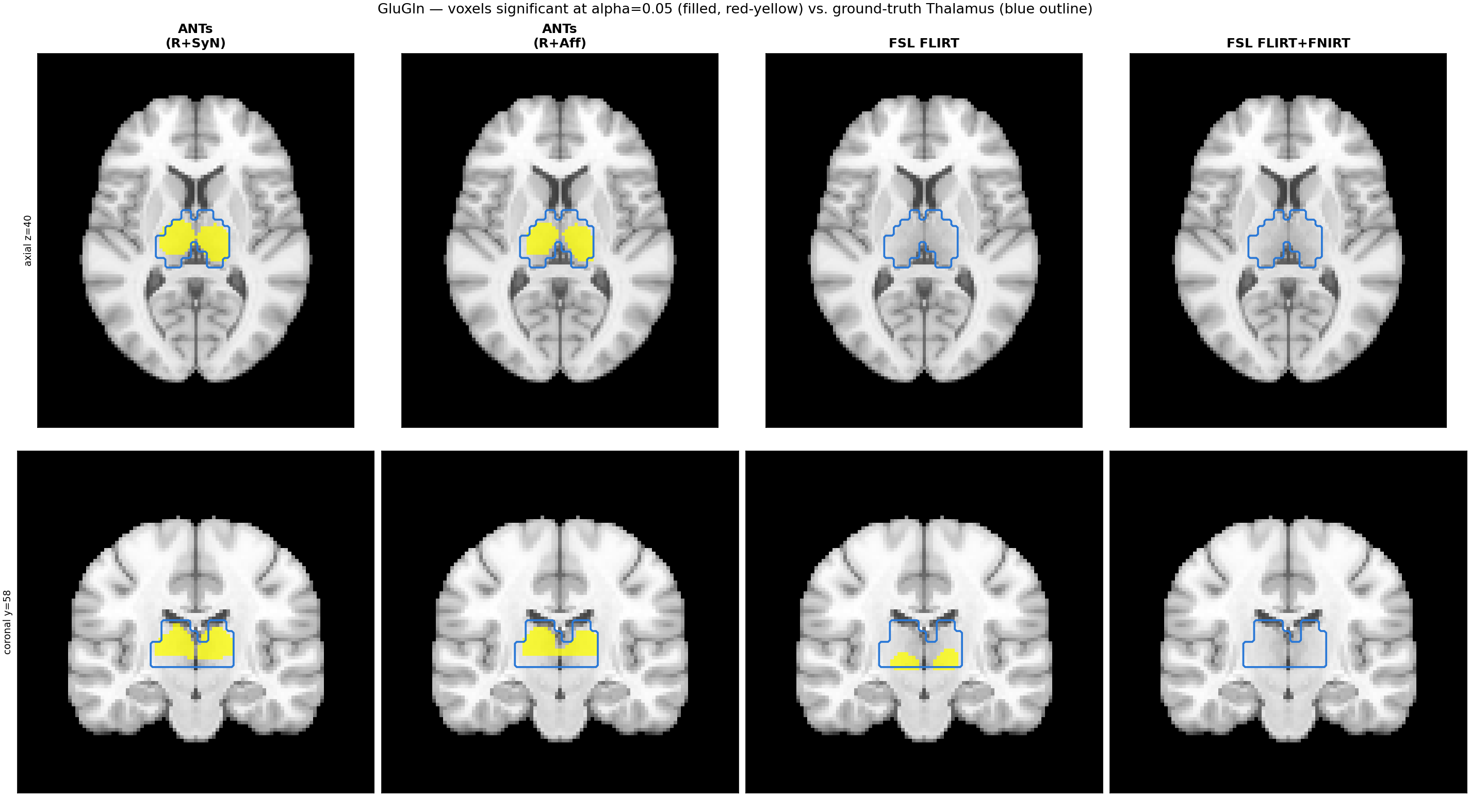
ANTs (both with and without the SyN stage) detects a clean, tightly
bilateral cluster inside the Thalamus. FSL FLIRT-only detects a real
but visibly asymmetric cluster (stronger on one side). FSL
FLIRT+FNIRT detects nothing at alpha=0.05 — zero significant
voxels at either slice — matching its near-chance ROC-AUC below.
ROC / Precision-Recall curves
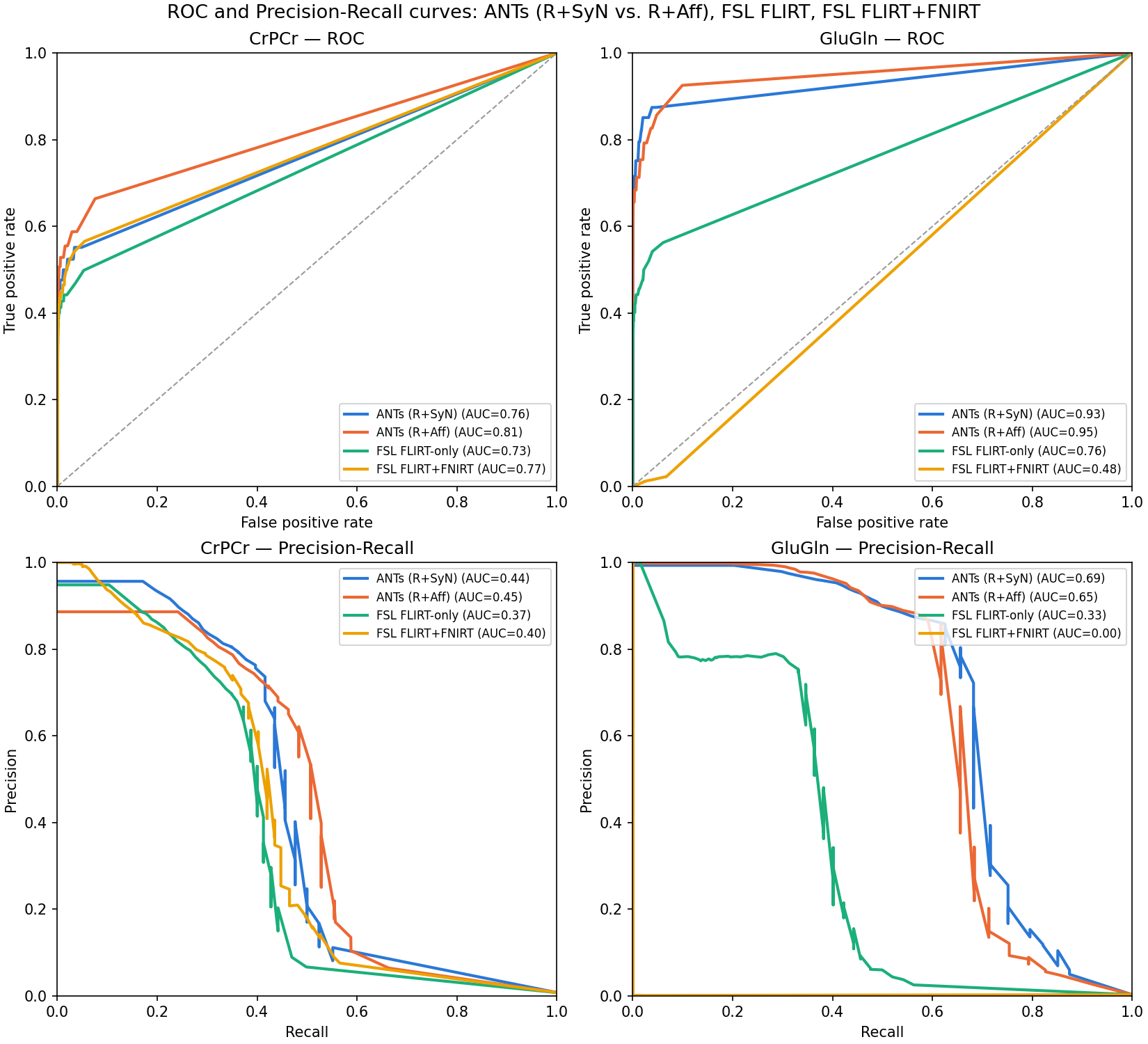
A single alpha=0.05 snapshot only shows one point on each backend's
detection tradeoff curve. Sweeping the TFCE-corrected significance
threshold (corrp) across its full range gives the complete ROC and
precision-recall curves and their AUC — a threshold-independent measure
of total discriminative power.
Backend |
CrPCr ROC-AUC |
CrPCr PR-AUC |
GluGln ROC-AUC |
GluGln PR-AUC |
|---|---|---|---|---|
ANTs (R+SyN) |
0.76 |
0.44 |
0.93 |
0.69 |
ANTs (R+Aff) |
0.81 |
0.45 |
0.95 |
0.65 |
FSL FLIRT-only |
0.73 |
0.37 |
0.76 |
0.33 |
FSL FLIRT+FNIRT |
0.77 |
0.40 |
0.48 |
0.00 |
ANTs (R+Aff) reuses the same MRSI→T1w/T1w→MNI registrations as the full ANTs run above, with the deformable SyN stage simply dropped from the resampling transform chain — see the "GM-precise boundary tracking" section below for why this variant was added and how it's computed.
Interpretation
ANTs is the best-performing backend on both metabolites, and the R+Aff variant is consistently at least as good as the full R+SyN pipeline — on GluGln it has the highest ROC-AUC of any backend (0.95), and on CrPCr it leads on both ROC-AUC (0.81) and PR-AUC (0.45). The deformable SyN stage does not clearly improve detection power over the R+Aff configuration on either metabolite in this benchmark.
FSL FLIRT+FNIRT is competitive with the ANTs variants on CrPCr (ROC-AUC 0.77, close to ANTs R+SyN's 0.76) but collapses to near-chance on GluGln (ROC-AUC 0.48, PR-AUC 0.00 — no better than random). This is specific to the Thalamus, a small, deep, centrally-located structure — consistent with the Registration Frameworks benchmark's (see the Benchmarks page) finding that FNIRT's nonlinear warp has higher signal-weighted leakage than ANTs or FLIRT-only: a small deep structure is exactly where local nonlinear-warp distortion would do the most damage to a focal signal.
FSL FLIRT-only is consistently the weakest backend on both metabolites, but still clearly above chance (ROC-AUC 0.73 and 0.76) — real detection power, just less than either ANTs variant.
Taken together with the Registration Frameworks benchmark, ANTs is the best-supported default for analyses where recovering a real, focal signal change matters — and since the R+Aff variant matches or exceeds full R+SyN's detection power here at a fraction of the registration cost (see the runtime comparison on the Benchmarks page), it is worth considering as the default over the full deformable pipeline for VBA workflows specifically. FSL FLIRT+FNIRT's extra registration cost does not translate into better — and for deep structures, translates into markedly worse — detection power than FLIRT-only.
GM-precise boundary tracking (CrPCr / Precuneus only)
The CrPCr/Precuneus injection above used the raw AAL atlas parcel, which is only ~62% gray matter in native T1w space (35,227 mm³ total parcel vs. 21,789 mm³ at CAT12 GM-probability >0.5) — its coarse boundary sweeps into adjacent white matter rather than tightly tracing the folded cortical ribbon. Bulk-overlap metrics like Dice can't tell whether a detected cluster actually tracks the true convoluted GM boundary, or just overlaps the same general neighborhood. This follow-up re-injects CrPCr's abnormality restricted to gray matter only, then adds a boundary-distance metric to directly measure boundary-tracking accuracy.
GM-only region source
Instead of intersecting the AAL parcel with a separate gray-matter
probability map, the injection's region source itself was switched to
mri_synthseg --parc's own DKT cortical labels
(ctx-lh-precuneus/ctx-rh-precuneus) for the same template subject —
these are inherently gray-matter-only, per-gyrus regions, so no separate
masking step is needed. The combined bilateral region shrinks from
35,227 mm³ (AAL) to 20,425 mm³ (SynthSeg) in native T1w space, and its
boundary is visibly more convoluted:
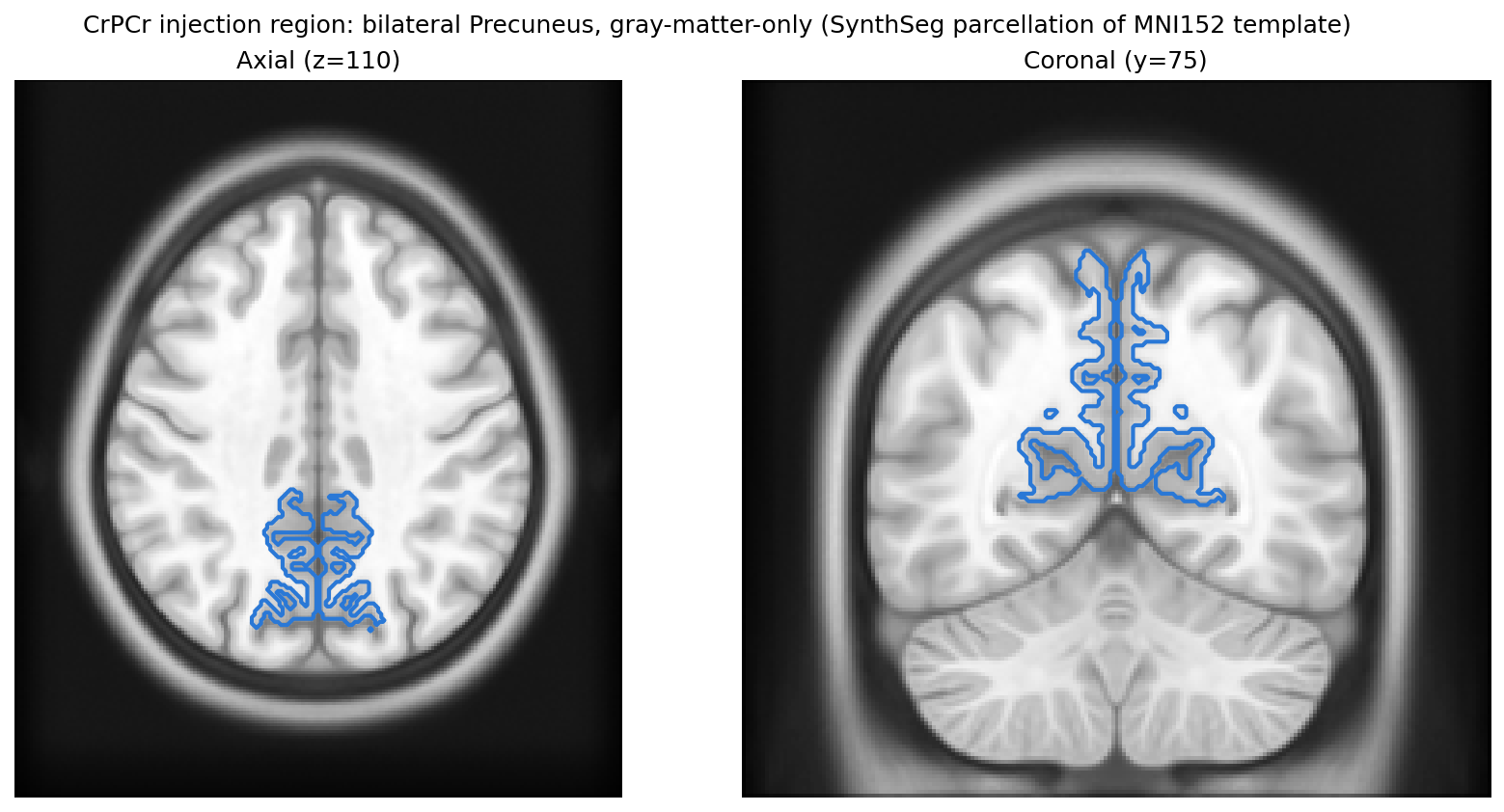
Only CrPCr's injection region changed — GluGln/Thalamus and the other three metabolites keep their original AAL-based regions unchanged (Thalamus is already a compact subcortical nucleus, not a folded cortical structure, so the boundary-complexity question doesn't apply there). The signal was re-filtered (same cluster-size-aware spike filter) and re-resampled into MNI space through each backend's already-computed registration transforms — no registration rerun, since registration depends only on anatomy, not on the injected signal.
Detection vs. the GM-precise ground truth
The population ground-truth mask used earlier in this report (the mean
of all 16 group=1 subjects' own injection masks) is appropriate for
the AAL-parcel comparison above, but is the wrong reference here: each
subject's own injected region is correctly gray-matter-only and
convoluted, but averaging 16 of them across their own individual
inter-subject registration variance smooths the union back out into a
diffuse, AAL-shaped blob (confirmed directly: no voxel is inside the
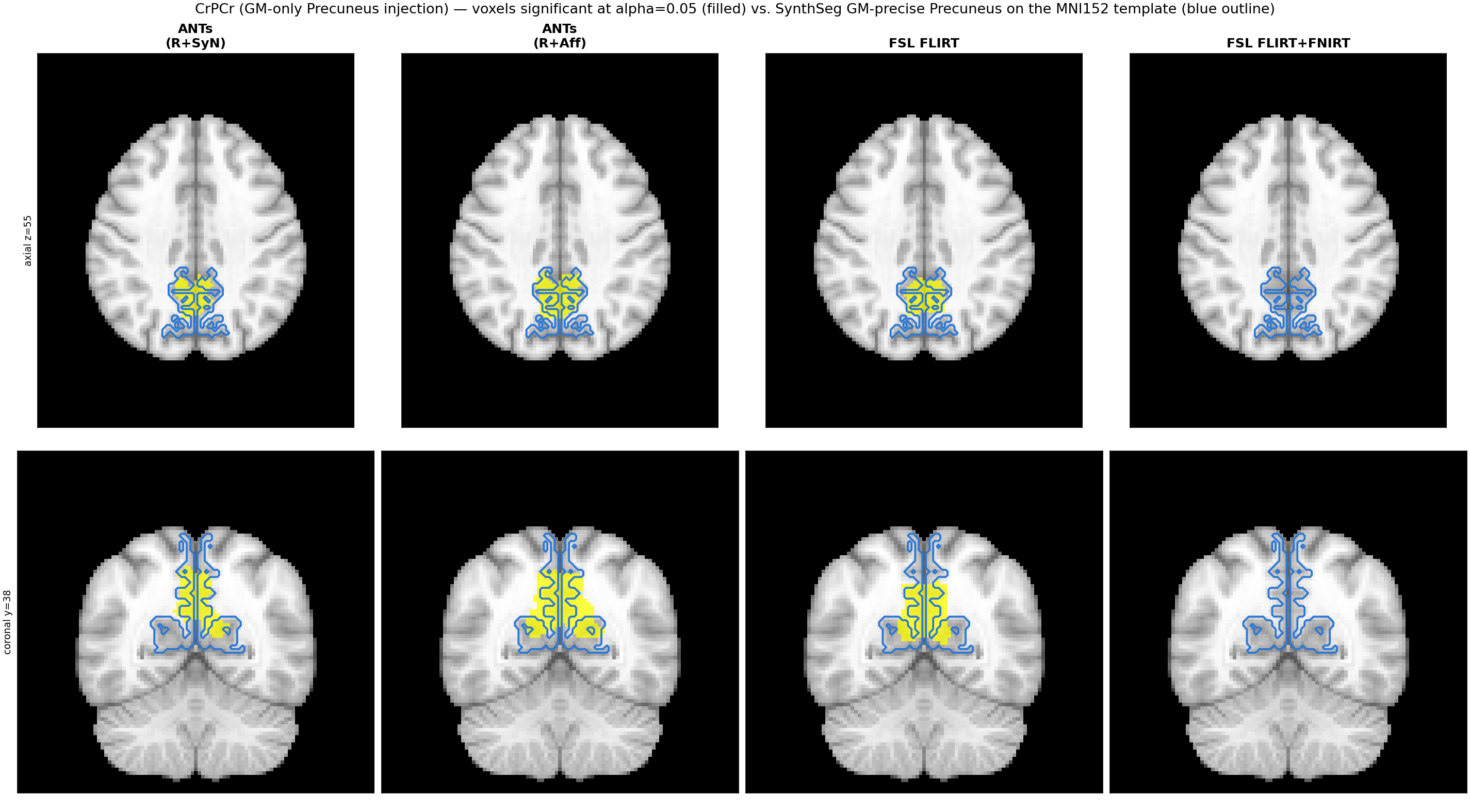
injected region for more than 50% of group=1 subjects). Instead, the
ground-truth outline below is mri_synthseg --parc's own segmentation
of the MNI152 template itself — the same fixed anatomical space
every backend's detected voxels are already shown in, so no
inter-subject registration variance is introduced and the true
gyrus-following boundary stays sharp:
Backend |
Dice |
Sensitivity |
Precision |
ROC-AUC |
PR-AUC |
|---|---|---|---|---|---|
ANTs (R+SyN) |
0.341 |
0.244 |
0.569 |
0.810 |
0.315 |
ANTs (R+Aff) |
0.432 |
0.374 |
0.510 |
0.849 |
0.326 |
FSL FLIRT-only |
0.326 |
0.250 |
0.470 |
0.773 |
0.238 |
FSL FLIRT+FNIRT |
0.017 |
0.009 |
0.721 |
0.815 |
0.268 |
ANTs (R+Aff) has the best Dice, sensitivity, and ROC-AUC of all four backends on this harder, GM-precise target — the deformable SyN stage actually reduces Dice here (0.341 vs. 0.432) relative to skipping it. This mirrors the pattern seen on the coarser AAL-parcel version of this benchmark above: SyN's nonlinear warp does not clearly help focal-signal detection, and on this metric actively hurts it.
Dice drops for every backend relative to the AAL-parcel version of this
benchmark — expected, since a tight, convoluted GM boundary is a
harder target to hit exactly than a bulk parcel. FSL FLIRT+FNIRT's
Dice collapses to 0.017 — visibly almost no detected voxels at
alpha=0.05 in the figure above — while its ROC-AUC (0.815) is close
to ANTs SyN's and not far off ANTs (R+Aff)'s. This combination
means FLIRT+FNIRT's corrp map does carry real discriminative signal,
but it is spread too diffusely (or offset) to ever cross the
TFCE-corrected significance threshold in the right place, rather than
lacking signal altogether.
Boundary-distance metric
Dice and ROC/PR-AUC summarize bulk voxel overlap and threshold-sweep
discriminative power, but neither directly measures where a detected
cluster's edge sits relative to the true boundary. experiments/compare_ground_truth_boundary.py
extracts the voxel-surface of the alpha=0.05 detected mask and of the
GM-precise ground-truth mask (the same MNI152-template SynthSeg
Precuneus segmentation used above), then reports the symmetric mean
surface distance and Hausdorff distance (mm) between them:
Backend |
Mean surface distance (mm) |
Hausdorff distance (mm) |
|---|---|---|
ANTs (R+SyN) |
5.47 |
23.07 |
ANTs (R+Aff) |
4.32 |
22.36 |
FSL FLIRT-only |
6.46 |
33.11 |
FSL FLIRT+FNIRT |
17.94 |
45.52 |
Interpretation
ANTs (R+Aff) tracks the true gray-matter boundary most closely of all four backends (4.32mm mean surface distance — under two and a half voxels at this 2mm resolution), narrowly ahead of full ANTs SyN (5.47mm) and FSL FLIRT-only (6.46mm). Skipping the deformable stage does not cost boundary precision here — if anything, it modestly improves it, consistent with SyN's effect on Dice above.
FSL FLIRT+FNIRT's boundary is roughly 3-4x farther from the true GM boundary than either ANTs variant (17.94mm mean, 45.52mm Hausdorff, vs. ANTs (R+Aff)'s 4.32mm/22.36mm) — this is the clearest signal in this follow-up that FNIRT's nonlinear warp, whatever discriminative power it retains (reflected in its ROC-AUC), is not spatially anchoring that signal to the correct convoluted cortical shape. Combined with its collapsed Dice, this reinforces the same conclusion as the Registration Frameworks benchmark's leakage finding: FNIRT's warp trades spatial precision for something that superficially still separates group1/group0 in aggregate, which is the wrong tradeoff for voxel-based analyses of focal cortical abnormalities.
Ranking is unchanged from the coarser AAL-parcel benchmark (ANTs variants ≥ FSL FLIRT-only ≫ FSL FLIRT+FNIRT), but the gap between FLIRT+FNIRT and the other backends widens substantially once the target requires tracking a genuinely convoluted boundary rather than bulk overlap with a smooth parcel — a harder, more realistic test of cortical-abnormality detection. Across both the AAL-parcel and GM-precise versions of this benchmark, ANTs' deformable SyN stage never clearly outperforms the no-SyN configuration for this kind of focal, planted-signal VBA detection task — its extra registration cost buys smoother anatomical correspondence in general, but not better recovery of a known focal abnormality.